Phase 1 (September 2024–March 2025)
A total of 28 primary schools in Bracknell Forest and the Royal Borough of Windsor & Maidenhead took part in the project, testing new ways to support neurodivergent children.
All participating schools were asked to complete the PINS self-assessment tool. This helped identify the strengths and weaknesses of each setting’s whole school approach to neurodiversity, including the areas in which the school would benefit most from support from health and education specialists and expert parents/carers.
Once completed, the self-assessments identified the following broad priority areas for additional support to schools:
- School leadership, culture and values – including understanding the needs of neurodiverse students by using data effectively and parent/carer views and involvement.
- Neurodiversity and mental health – including having a whole school approach to emotional wellbeing and mental health and fostering connections with local, community-based emotional wellbeing and mental health services
- Teaching and learning – including using evidence-based approaches to improving support and using classroom resources and teaching assistants
- Sensory and physical environment – including sensory audits
- Language environment – classroom language for learning, including classroom language audit
Based on these results, each school was able to choose activities to help them better support neurodivergent children from the following menu of support:
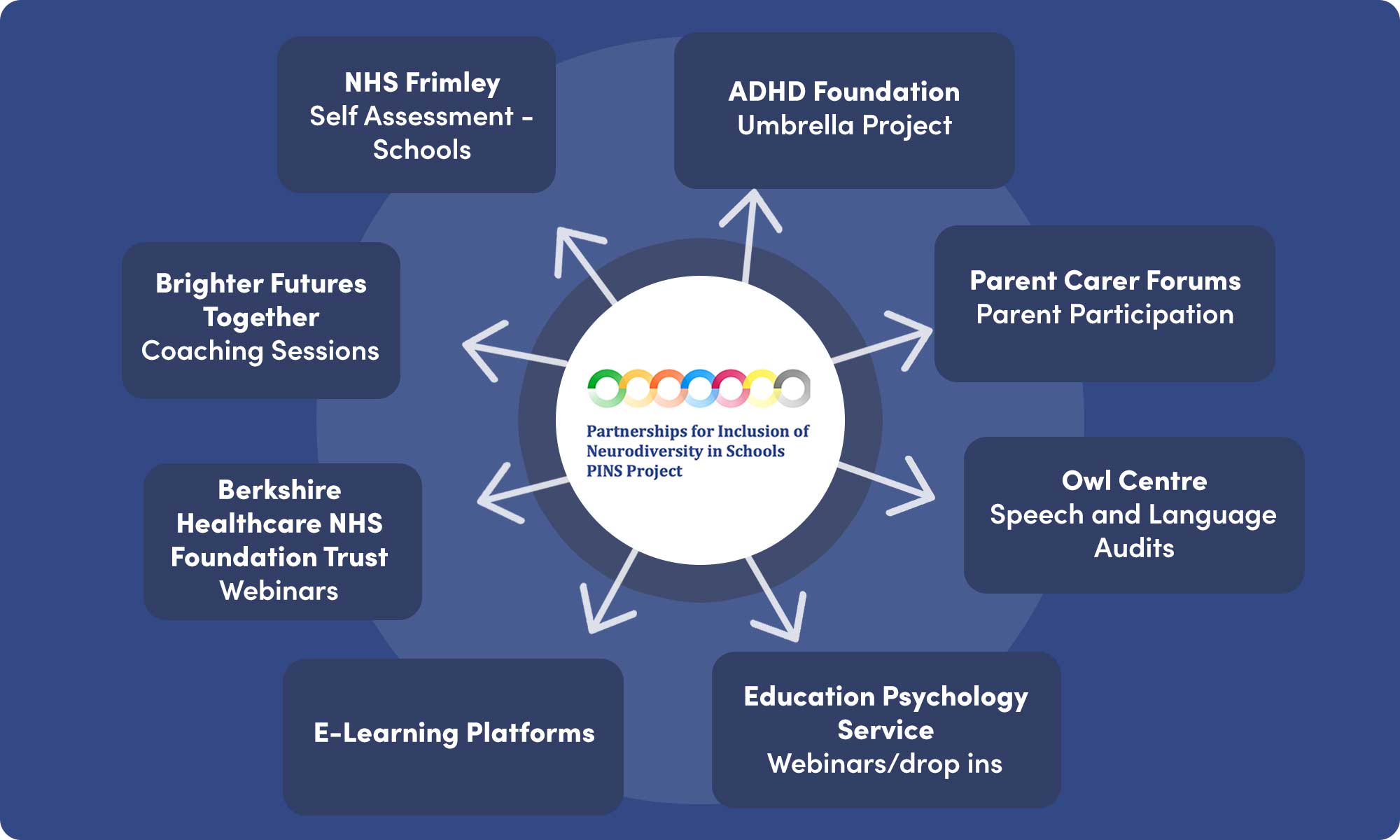
You can read the Year 1 report for the evaluation of the Partnerships for Inclusion of Neurodiversity in Schools (PINS), led by CFE Research and Cordis Bright with academics from the University of Exeter here.
Click on the activity for more information.
NHS Frimley self-assessment tool for schools
To support the successful delivery of the PINS local project, all the participating schools were asked to complete a self-assessment tool, which sought input from school leaders, SENCOs and the governing body, to be considered alongside the school’s children’s and parents’/carers’ voice feedback wherever possible.
The self-assessment tool covers a list of broad domain areas, including: leadership, culture and values; mental health; readiness to learn; teaching and learning; and environment and communication.
Once completed, the self-assessment process identified priority areas for additional support to schools from health and education specialists and parents/carers and formed the basis for the menu of support.
For a copy of the self assessment click here
ADHD Foundation Umbrella Project
In partnership with the ADHD Foundation, Brighter Futures Together hosted mini umbrella installations in local schools to celebrate and promote understanding of neurodiversity.
Every school that signed up received a pack of a pack of 25 brightly coloured umbrellas to create their own display, as well as posters, information packs and lesson plans and assembly presentations focusing on neurodiversity. School communities were also offered the chance to attend two neurodiversity training webinars for staff and two for parents/carers.
Parent Carer Forums
Bracknell Parent Carer Forum (Bracknell PCF) and Royal Borough of Windsor and Maidenhead Parent Carer Forum carried out a parent/carer survey’s to gather feedback and insights from families, helping shape how the 28 participating schools develop their SEND provision. PCFs were also instrumental in holding participation sessions in schools, creating spaces where parents/carers came together to share their experiences and contribute to school improvements.
Owl Centre speech and language audits
The Owl Centre Speech and Language Audits have supported schools in creating more inclusive learning environments by identifying and addressing diverse communication needs across the student population.
In addition to an introductory webinar, this offer included access to a self-assessment tool to help schools evaluate their current knowledge, identify challenges and understand the specific language support needs within their student population. After the self-assessment was completed, schools had an onsite visit by a licensed therapist who then provided a school-specific report
The onsite visits and tailored reports have provide practical recommendations to improve classroom communication strategies, reduce barriers to participation, and enhance staff confidence in supporting a wide range of learners. By embedding inclusive communication practices across the school, the audits have helped create a more accessible and supportive environment for all students.
You can access the self-assessment tool, as well as other useful resources, on our Resources page
Educational Psychology Service webinar and drop-ins
Bracknell Forest Educational Psychology Service offered SEND coordinators from schools in Bracknell Forest and the Royal Borough of Windsor and Maidenhead the chance to attend ‘drop-in’ facilitated group consultations. These events provided opportunities for attendees to discuss with their peers issues they were encountering in their schools relating to neurodiversity and to gain an Educational Psychologist’s perspective.
The service also delivered a webinar for schools entitled ‘Neurodiversity awareness & the BFC Neurodiversity Person Centred Tool’. To access a recording of the webinar, please click here.
Berkshire Healthcare NHS Foundation Trust Children and Young People’s and Families Service – Webinars
NHS CAMHS and Children and Young People’s Integrated Therapies teams invited school staff and professionals working with children and young people to attend four webinars featuring guest experts. The webinars were:
Supporting language and communication in the classroom
Topic: strategies to support children’s language and communication development in the classroom.
Presented by: Hannah Mulvihill, Speech and Language Therapist, Berkshire Healthcare Foundation Trust.
Supporting CYP with neurodivergence who are self-harming and/or presenting with risk
Topic: Understanding strategies and risk/ safety planning processes.
Presenter: Yani Chocalingum, Team Lead for Bracknell Mental Health Support Teams and CAMHS Getting Help Teams, Berkshire Healthcare Foundation Trust.
Supporting CYP with neurodivergence and anxiety
Topic: Exploring how the Mental Health Support Team have adapted their anxiety workshop (Whole School Approach) to support young people with anxiety who have neurodivergence.
Presenters: Kate Clemmings, RBWM MHST lead clinician and supervisor/ CBT practitioner, Berkshire Healthcare Foundation Trust; Josie Sebire, Education Mental Health Practitioner, RBWM MHST, Berkshire Healthcare Foundation Trust.
Topic: How mental health issues present in children and young people with autism, with a focus on anxiety, depression and OCD and how to support young people and their families with autism and mental health difficulties.
Presenters: Peter Saunders Clinical Supervisor, Berkshire Healthcare Foundation Trust CAMHS Getting Help and Mental Health Support Team; Faye Franckel, Clinical Supervisor, Berkshire Healthcare Foundation Trust CAMHS Getting Help and Mental Health Support Team.
Please click here on the presentation titles above to access recordings of the webinars or you can access them on our Resources page
Brighter Futures Together coaching sessions
Schools were offered two days of coaching from a Neurodiversity Schools Advisor to help them better support pupils and their families. Each school that signed up initially met with the advisor to go over the self-assessment done at the start of the project and the views of parents/carers gathered by the Parent Carer Forum. The school then agreed which areas of improvement they wanted to work on and what help they needed from the advisor to achieve this.
The advisor provided a range of tailored support to schools, including: coaching in how to work with parents/carers to create a newsletter, policies and other documents; reviewing Behaviour Policies and how to make them more neurodivergent friendly; explaining how to work with an individual pupil to draw up a Behaviour Plan; observing classes and offering ideas to improve how the school supports neurodivergent pupils.
E-learning platform
Do-It Solutions, supported by Brighter Futures Together, offered twelve schools access to a one-year licence for the Neurodiversity for Educators E-learning platform and resources.
Each licence allowed 25 individuals within the school to access online resources and 19 brief ‘lessons’ promoting a better understanding of neurodiversity in an educational context to support neurodivergent learners and create more neuro-inclusive learning settings.
For more information about the E- Learning Platform click here